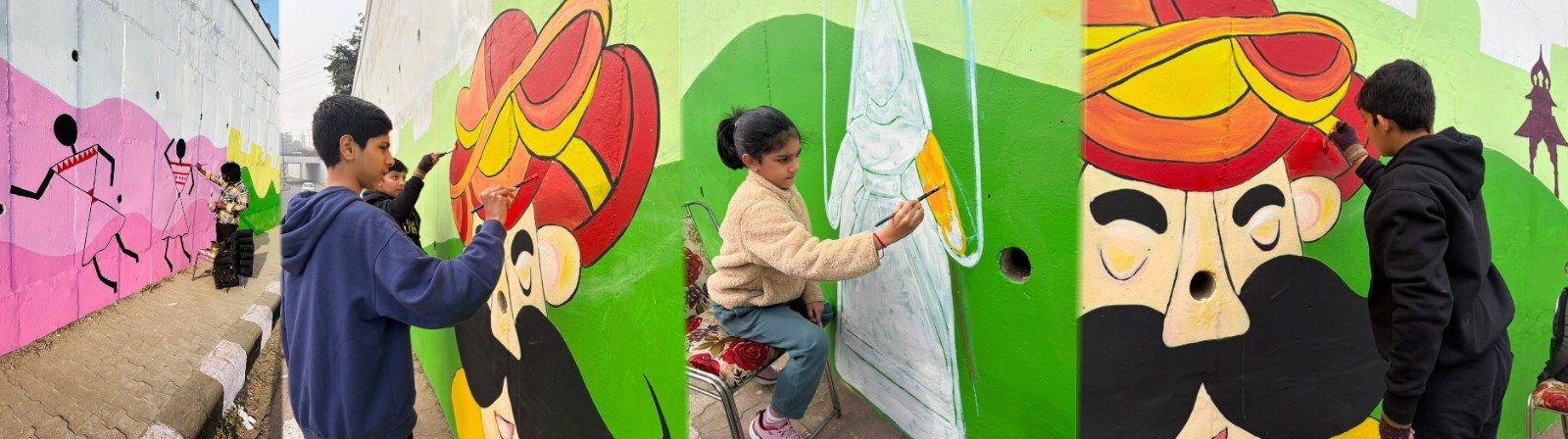
The Sector 5 and 6 underpass in MDC Panchkula has long served its utilitarian purpose, a concrete passage facilitating the movement of vehicles and pedestrians between two busy sectors. For most residents, it remained an unremarkable feature of urban infrastructure, noticed only in passing. That is no longer the case.
Over recent weeks, the underpass has undergone a remarkable transformation, its grey walls now adorned with vivid murals celebrating the cultural and artistic heritage of Haryana and India. The project, commissioned by the Panchkula Metropolitan Development Authority (PMDA) and executed by the staff of Dbels (Dass & Brown Experiential Learning School), has turned an ordinary thoroughfare into an informal gallery of regional art and tradition.
The significance of this initiative extends beyond mere aesthetics. Public art, when executed thoughtfully, serves as a medium of cultural preservation and civic identity. The murals at the MDC Sector 5-6 underpass accomplish precisely this. They incorporate traditional motifs drawn from Haryana's folk traditions, depictions of rural life that recall the agrarian roots of the region, and classical artistic elements that speak to the broader Indian cultural inheritance. For the thousands who traverse this passage daily, the artwork offers a moment of connection with heritage that might otherwise remain confined to museums and textbooks.
What makes this project particularly noteworthy is its provenance. Dbels, recognised as India's First School of Entrepreneurship, operates on a pedagogical model that integrates Finnish early years methodology with Cambridge curriculum and embedded entrepreneurship education. The institution's involvement in a public beautification project may, at first glance, appear tangential to its educational mission. In reality, it reflects a coherent institutional philosophy regarding the relationship between schools and their surrounding communities.
Educational institutions have historically occupied a peculiar position in civic life. They draw resources and students from their communities, yet often remain insulated from broader civic concerns. The walls of the school, both literal and metaphorical, demarcate a boundary between learning and living. Dbels' participation in the underpass project represents a deliberate challenge to this separation. The school's staff, in undertaking this work, demonstrated that the skills and creativity cultivated within educational settings need not remain confined there.
Ms. Anju Mehta, Principal of Dbels, articulated this perspective: "This project represents our institutional philosophy of extending learning and contribution beyond the confines of the classroom. We are honoured that PMDA entrusted us with the responsibility of transforming this public space. The artwork stands as a tribute to the cultural wealth of Haryana and serves as a daily reminder to all who pass through of the artistic heritage we collectively inherit."
The choice of subject matter for the murals deserves attention. In an era when public spaces are increasingly dominated by commercial imagery and digital screens, the decision to foreground traditional cultural motifs carries intentional significance. The artwork does not merely decorate; it educates. It invites viewers to consider the artistic traditions that have shaped regional identity over centuries. For younger residents who may have limited exposure to folk art forms, the murals serve as an accessible introduction. For older residents, they offer recognition and validation of cultural knowledge that modernity often overlooks.
The response from the public has been considerable. Social media platforms have seen numerous posts featuring the transformed underpass, with residents expressing appreciation for the beautification of a previously neglected space. This organic attention speaks to a latent civic desire for public spaces that reflect local identity and artistic investment. When given the opportunity to engage with meaningful public art, communities respond with enthusiasm.
The collaboration between PMDA and Dbels also offers a model for future civic projects. Municipal authorities possess the mandate and resources to undertake beautification initiatives but may lack the creative capacity or community connections to execute them effectively. Educational institutions, conversely, possess talent and vision but may lack opportunities for public application. The MDC Sector 5-6 underpass project demonstrates how partnerships between these entities can yield outcomes that neither could achieve independently.
The transformation of the MDC Sector 5-6 underpass stands as evidence that public spaces need not remain utilitarian voids. With vision, collaboration, and institutional commitment, they can become sites of cultural expression and community pride. Panchkula is richer for this initiative, and one hopes it marks the beginning of a broader movement toward meaningful public art across the tricity region.
The concrete walls of the underpass, once blank and forgettable, now speak. They speak of Haryana's traditions, of India's artistic inheritance, and of an educational institution that understands its responsibilities extend far beyond the classroom. Those who pass through would do well to pause, if only briefly, and listen.